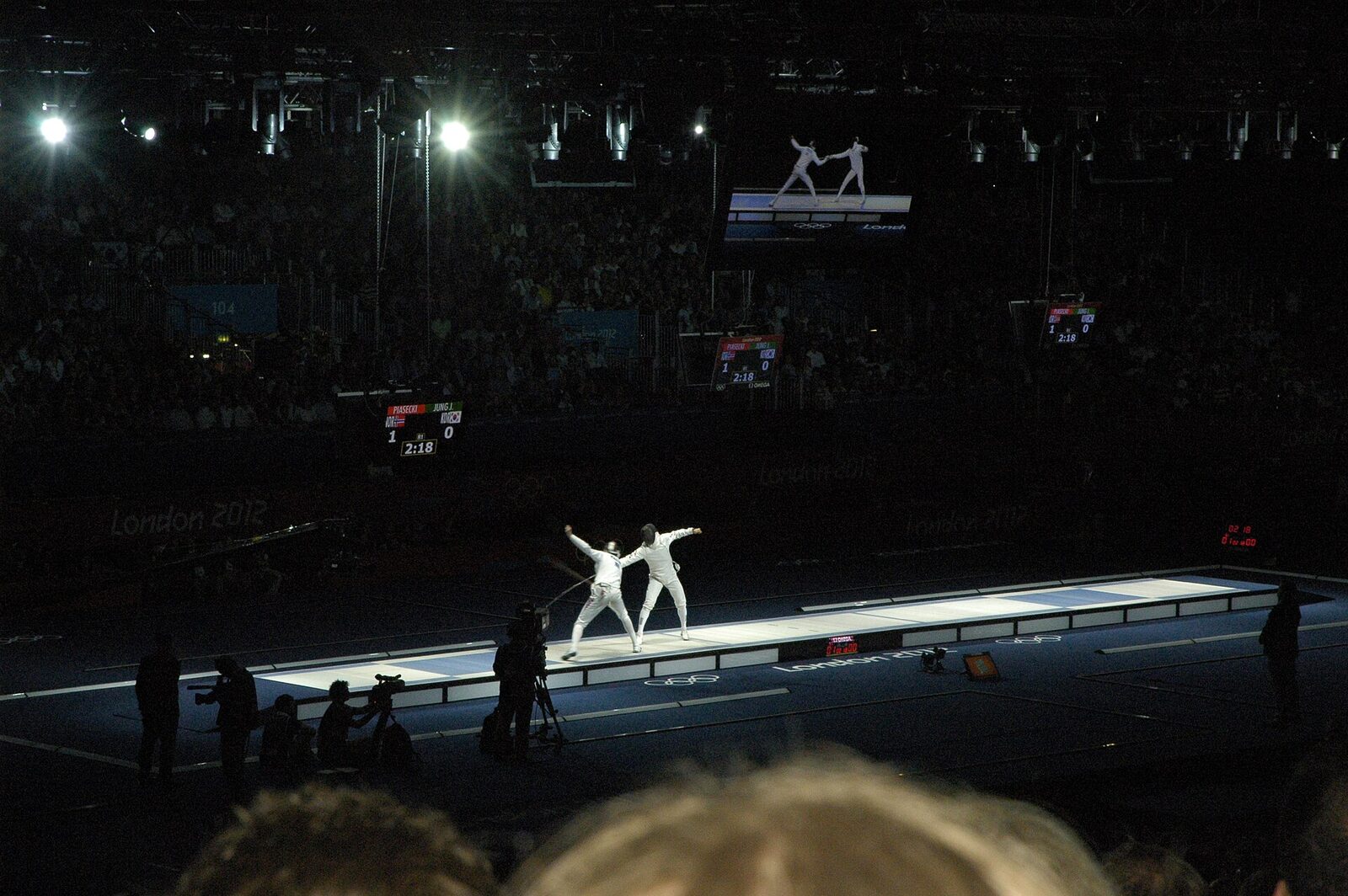
Welcome to the Olympic Sport of Fencing!
Welcome to Fencing.net! If you just watched fencing at the Olympics and want to understand what you saw, this is a great place to start. We’ve collected information from across the internet, high quality informative articles, and answers to common questions all in one spot to help you make sense of fencing, the sport and Olympic event.
Maybe you saw fencing on television at the last Olympics. Or you loved The Princess Bride as a kid. Either way, fencing is a sport people of all ages and abilities can enjoy.
Want to Try Fencing Yourself?
This particular guide is about understanding what you watched. If it made you want to pick up a blade yourself, head straight to Learning to Fence: Getting Started in the Sport of Fencing — our step-by-step guide to finding a club, joining a beginner class, and taking your first steps in the sport.
What is sport fencing?
Fencing (also known as sport or Olympic fencing) is a sport in which two people use modern variations of swords to score points by hitting their opponent on a valid target area. The “sport” or “Olympic” qualifier is typically added to distinguish the modern sport from historical re-enactment activities. Fencers use electronic scoring devices to register touches, while referees administer the rules and arbitrate the flow of the match. There are three events inside the sport, each with a different set of rules: foil, epee, and saber.
The Three Weapons of Fencing
Fencing has three weapons — foil, epee, and saber — and each is essentially its own sport layered on the same footwork. They differ along three axes: where you’re allowed to hit (target area), how a touch is scored (point vs. edge), and whether “right of way” rules apply.
| Foil | Epee | Saber | |
|---|---|---|---|
| Target area | Torso only | Entire body | Waist up, including the mask |
| How touches score | Point (tip) only | Point (tip) only | Point or edge — the whole blade counts |
| Right of way? | Yes | No — simultaneous hits both score | Yes |
Foil is a point weapon, which means touches are scored only by depressing a button at the tip of the blade against the valid target area — the torso. Foil is also a conventional weapon, which means that if both fencers land a hit within the same fraction of a second, the referee applies a set of priority rules — “right of way,” explained below — to decide who scores.
Epee (pronounced “EPP-ay”) is also a point weapon, but the entire body is valid target, from mask to shoe. Unlike foil and saber, epee has no right-of-way rules: if both fencers land a hit within about 40 milliseconds of each other, both score a touch. It’s closer to the logic of an actual duel, where landing first — or simultaneously — is what matters, not who was “attacking.”
Saber is fencing’s only edge weapon, which means a hit with any part of the blade, not just the tip, counts as a touch, much like a slashing cavalry sword. Valid target is the waist up, including the mask — a nod to saber’s cavalry roots, where a mounted opponent’s legs were out of reach. Saber is also a conventional weapon and uses right of way, like foil.
What Do the Scoring Lights Mean?
Every touch in fencing is registered electronically. When a fencer lands a valid touch, a colored light — green for one side of the strip, red for the other — lights up on the scoring apparatus. In foil, a hit that lands on a non-target area (arms, legs, mask) lights up white instead; it stops the action but doesn’t score a point. That’s what those flashing lights on the broadcast were telling you.
Frequently Asked Questions about Fencing
How do I get started with fencing?
If you want to actually pick up a foil, epee, or saber yourself, your best move is finding a local club — nearly every region has one within a reasonable drive, and clubs run beginner classes designed for people who’ve never touched a blade. We’ve written a full step-by-step guide to get you there: Learning to Fence: Getting Started in the Sport of Fencing.
What is “Right of Way”?
The basic premise behind “right of way” is that if you are being attacked, you must deal with that attack before launching an attack of your own. This originates from dueling practices, where if both people just stab each other, you don’t really have a winner of that duel. So, if there are two lights on the scoring apparatus in foil or saber, the referee decides who had right of way, whose touch had scoring priority, and therefore who scored the point (if anyone did). Epee doesn’t use right of way at all — see the weapon breakdown above.
Is there Paralympic fencing?
Yes — wheelchair fencing is a full Paralympic sport, contested in foil, epee, and saber just like the able-bodied game, with each fencer’s wheelchair locked to a fixed frame so bouts are fought at a set distance rather than with footwork. It’s featured at the Paralympic Games, held separately from the Olympics you just watched.
If you’re wondering whether a disability or medical concern would keep you from fencing yourself, the short answer is almost certainly not — able-bodied fencing is broadly accessible too. Consult your physician first if you have a specific concern, then see our guide to getting started for what to expect at your first class.
Catching Up on the Games
Want the results, not just the rules? Fencing.net has coverage of recent and upcoming Olympic fencing: Tokyo 2020 medal-by-medal results, Paris 2024 results across all 12 events, and a preview of what to expect at Los Angeles 2028.
Other Great Fencing Resources Online
- The FIE - the international governing body for the sport.
- USA Fencing - the national governing body for the sport inside the US.
- Better Fencer - a resource run by Olympian Jason Rogers on various topics related to improving your fencing.
- AskFRED - the best place online to find local tournaments, camps and clinics.
- FIE Video - the official YouTube channel of the FIE. Tons of great video here.
- A Primer on Fencing Rules and Refereeing - our own reference guide to the rules and how referees run a bout.